
How Brusly Police Department Digitized Warrants, Contracts, and Protective Orders
The Operational Challenges of Paper-Based Records
Before automation, Brusly Police Department relied on paper files and decentralized storage for several critical record types.
Contract management presented ongoing administrative risk. Contracts were stored across physical locations with no centralized tracking or automated reminders. Renewal dates depended on manual follow-up, increasing the likelihood of missed deadlines.
Warrant filing was equally constrained. Warrants were sorted and filed manually, making retrieval slow and highly dependent on staff familiarity with the filing system. Searches could take days, especially when information was incomplete or misfiled.
Protective orders posed a more serious concern. Paper tracking provided no systematic way to monitor expiration dates or ensure timely awareness across the department. Without alerts or centralized visibility, protective order management relied heavily on individual diligence rather than system controls.
Collectively, these challenges limited efficiency, increased exposure to error, and made audit preparation reactive rather than routine.
Designing a Practical Automation Approach
The solution implemented by JPI focused on targeted automation of high-risk, high-impact records rather than a full system overhaul.
For contract management, Laserfiche Cloud was configured to automatically rename documents, store them in a centralized repository, and trigger renewal alerts at 60 and 30 days. This replaced informal tracking with a structured, repeatable process.
Warrant filing was digitized with metadata capture and standardized naming conventions. Warrants are now automatically organized alphabetically, allowing staff to locate records in minutes rather than days.
Protective orders were fully digitized and indexed with metadata, enabling consistent tracking and automated expiration reminders. The system supports fast searches while improving visibility into active and expiring orders.
Each automation was designed to fit existing departmental workflows, reducing disruption while increasing reliability.
Measurable Operational Outcomes
The impact of automation was immediate and measurable across multiple areas.
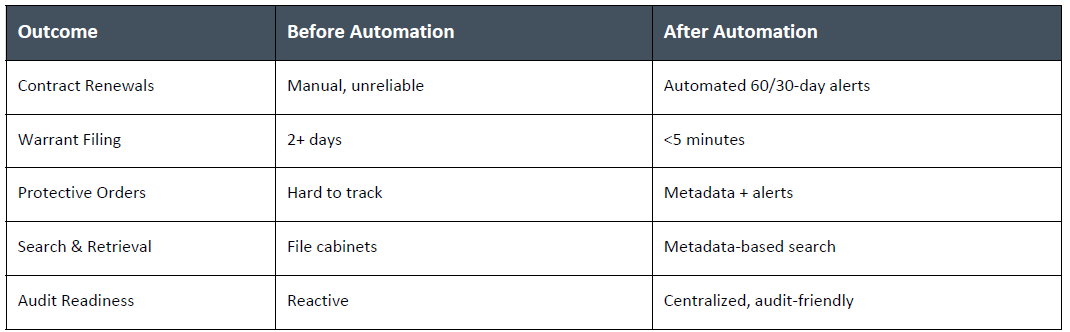
Contract renewals shifted from unreliable manual tracking to automated notifications. Warrant filing time dropped from more than two days to under five minutes. Protective orders became searchable and proactively monitored through metadata and alerts.
Search and retrieval moved from file cabinets to metadata-based queries, significantly improving access speed. Audit readiness improved as records became centralized, standardized, and easier to review.
These outcomes demonstrate that meaningful efficiency gains are achievable without expanding staff or introducing complex infrastructure.
A Scalable Model for Small Agencies
Brusly Police Department’s experience shows that automation is not limited to large or resource-heavy agencies. With focused scope and the right implementation partner, small departments can eliminate paper bottlenecks, improve operational control, and strengthen compliance posture.
The approach used here emphasizes practicality. Automate what matters most. Centralize records that carry risk. Build systems that support day-to-day operations rather than adding administrative burden.
About JPI Data Resource
JPI Data Resource is a Premier Laserfiche Solution Provider with more than 23 years of experience in document management and workflow automation. JPI works with public sector and commercial organizations to design secure, compliant systems aligned with real operational needs.
This case study reflects JPI’s approach to applied automation. Focused, governed, and built for production use.
Wanna to see how this looks in practice? schedule your free demo Here.
OR contact us at info@jpidr.com.